Guide to buying skateboards
Dreaming of skating like Paul Rodriguez or Rob Dyrdek — or just cruising the streets and skatepark with style? It starts with your first complete skateboard and, more importantly, the right setup for you. Euroskateshop is here to walk you through it. Take a look at all our skateboards online or in store.How do you choose a skateboard?
Euroskateshop offers a wide range of skateboards and parts. That is great if you know what you want — but if you are a beginner, or you have ridden the same setup forever and want something new, you might need a hand. We cover everything you need to choose right, whether you buy a complete board or upgrade part by part.Worth knowing if you buy a complete skateboard:
If you are a beginner and do not want to build a custom setup, check our pre-built completes. Euroskateshop complete skateboards use the same quality parts you can buy separately on the site.
1. Skateboard / Introduction
See complete trick skateboards
A skateboard is not just a skateboard. Supermarket and rental boards often use weak wood and poor construction. Bearings, wheels and trucks are thrown together without much thought. At Euroskateshop, every complete is built by brands that know skateboarding and make real boards.
You can buy a complete board ready to ride. To build your own, you need:
- Skateboard deck
- A set of trucks (2 pcs.)
- A set of wheels (4 pcs.)
- A set of bearings (2 per wheel = 8 total)
- Hardware (8 bolts and nuts to mount trucks to the deck)
- Griptape (grip surface on top of the deck)

2.1 Skateboard deck / Introduction
Buy skateboard decks
The deck is the platform you stand on and shred. Decks are traditionally made from multiple maple plies (7 is typical), which gives strength and pop.
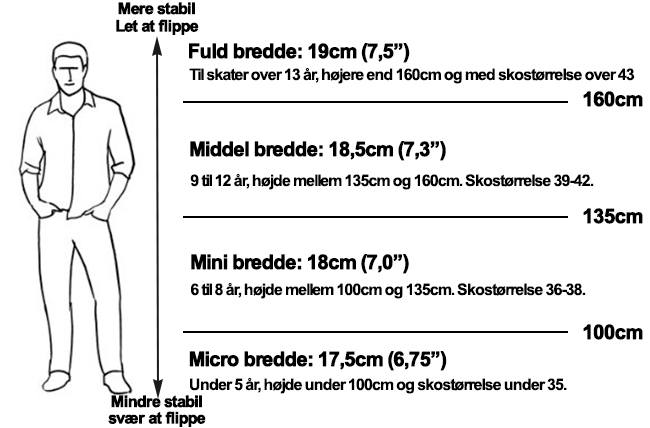
Width is the main starting point. Different widths suit different styles. As a rule of thumb, pick a deck slightly narrower than the length of your foot.
Length matters too if you are shorter or want a small cruiser. See the chart and pick the right size.
2.2 Skateboard deck / Width
Standard skateboard width (not longboards, cruisers or mini-cruisers) runs from 19.0 cm (7.5") to 21.5 cm (8.5"). Inches are the norm in skateboarding — get used to them.
Wider decks are more stable but often harder for flip tricks. Narrower decks are more responsive for tricks but less stable.

2.3 Skateboard deck / Wheelbase
Wheelbase is the distance between the mounted truck axles. It is personal preference and should fit your build — longer legs often want a longer wheelbase. Wheelbase affects turning radius: shorter = tighter turns, longer = wider turns.

2.4 Skateboard deck / Concave and shape
Each brand — and each board line — has its own shape and concave profile.
Concave is the curve between the deck rails. It affects how tricks feel. Flatter decks with mild concave can suit technical flip tricks; deeper concave often feels more locked in and easier to control.

3.1 Skateboard trucks / Introduction
See all skateboard trucks
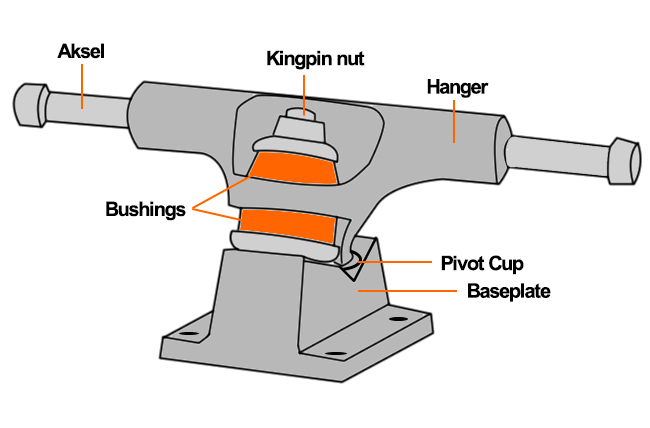
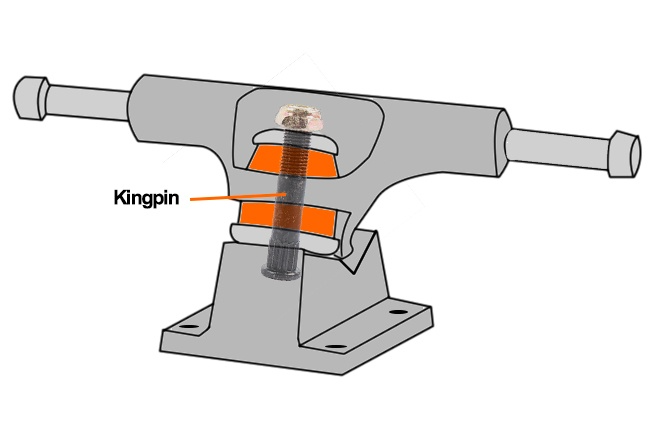
Trucks mount the wheels to the deck and let the board turn and lean. Tightening the kingpin nut compresses the bushings for a stiffer feel — more stability, harder to turn. Looser trucks turn easier; tighter trucks can help pop. Bushings and kingpin tension change how your trucks steer. Trucks come in different widths — match them to your deck width.
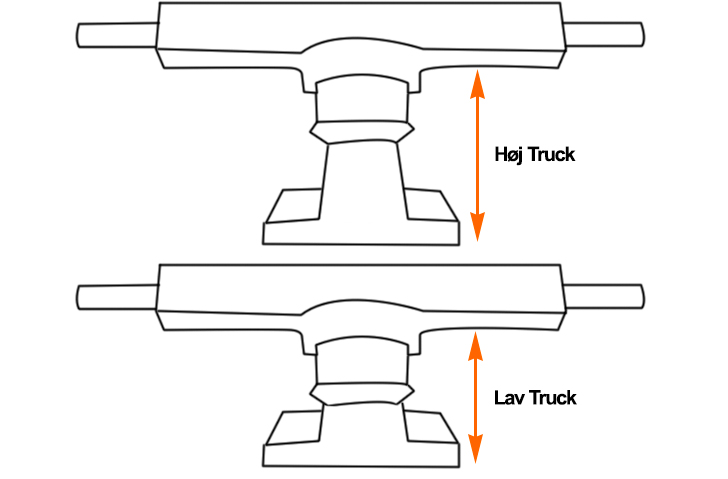
Truck heights are generally LOW, MEDIUM and HIGH — each suits different styles.
3.2 Skateboard trucks / Truck height
LOW — Best for flip tricks and stability. Pairs well with smaller wheels to reduce wheel bite. Good for beginners thanks to a lower center of gravity (Euroskateshop recommends 50–53 mm wheels).
MEDIUM — The most common all-around choice for street and park (Euroskateshop recommends 53–56 mm wheels).
HIGH — Popular for cruising and carving, less focused on flip tricks (Euroskateshop recommends 56 mm+ wheels).
3.3 Skateboard trucks / Axle width
Hardware length depends on deck thickness and whether you use riser pads (see section 8.1).
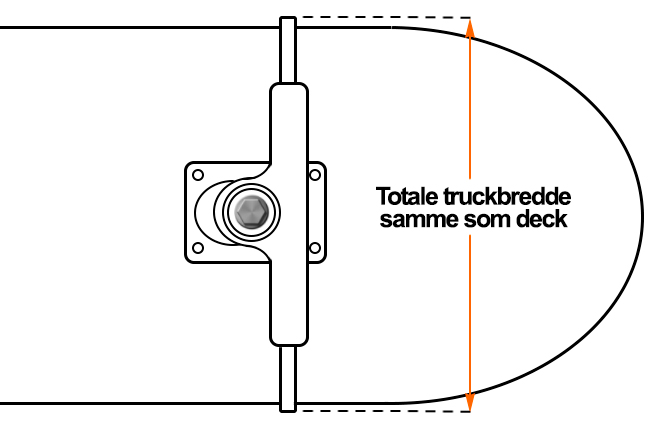
Truck size follows hanger/axle width in inches (see diagram). As a rule, axle width should match deck width. Most trucks fit decks from 7.5" to 8".
General guidelines:
6"–7.25" axle — 6.5" to 7.25" decks
7.5" axle — 7.25" to 7.5" decks
7.75" axle — 7.5" to 8" decks
8.0" axle — 8" to 8.5" decks
8.5" axle — 8.5" to 9" decks
9.0" axle — 9" to 10" decks
10.0" axle — 10" and up
3.4 Skateboard trucks / Bushings
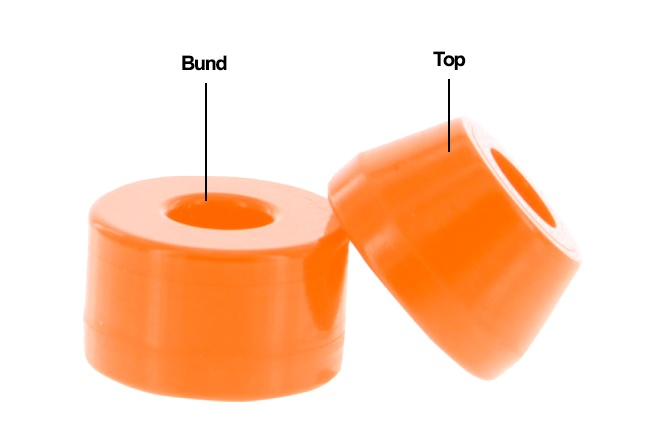
Bushings are the urethane cushions between the kingpin and hanger — two per truck. Harder bushings resist turn but snap back with more energy; softer bushings absorb impact and turn more easily. Kingpin nut tension also changes how your board steers.
3.5 Skateboard trucks / Kingpin
The kingpin is the bolt that holds the bushings and hanger together. The kingpin nut sits on top — that is what you tighten or loosen to adjust your trucks.
4.1 Skateboard wheels / Introduction
Shop skateboard wheels
Two main choices when buying wheels: diameter (agility, speed, comfort) and durometer (grip vs roll speed). Both depend on whether you ride street, park, pool or cruise.
2: Diameter affects agility, speed and comfort (see below).
1: Durometer affects grip and speed (see below).

4.2 Skateboard wheels / Diameter
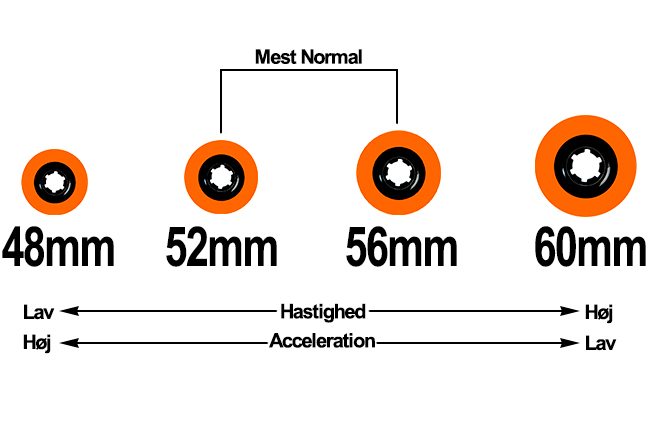
Wheel diameter is measured in mm and usually printed on the wheel. Street and park skating typically uses 50–60 mm; wheels over 60 mm are common on longboards and cruisers.
Smaller wheels (50–54 mm) are slower and can hang up on cracks, but street and technical skaters like them for lower weight and flip-trick control.
Larger wheels roll faster and roll over cracks better, but add weight. Beginners often start around 54–55 mm.
50–54 mm — Smaller and slower; preferred for street and technical skating.
54–58 mm — Versatile all-around size; a good beginner range.
58 mm+ — Faster and better for cruising and longboarding; tricks get harder due to size and weight.
4.3 Skateboard wheels / Hardness (durometer)
Durometer measures wheel hardness. Harder wheels roll faster; softer wheels grip more but roll slower.
Most skate wheels use the A scale (1–100). Some brands use the B scale (20 points harder — e.g. 80B ≈ 100A). The average street wheel is around 99A.
78A–87A — Soft; smooth on rough surfaces, cruising, longboards and hills.
88A–95A — Slightly harder, still good grip on rough pavement.
96A–99A — The all-around sweet spot for street, park, ramps and pools.
101A+ — Hardest and fastest with least grip; pro street wheels.
83B–84B — Very hard B-scale wheels for maximum roll speed.

5.1 Skateboard bearings / Introduction
See all skateboard bearings
All standard skateboard bearings are the same size (608) — size is not a factor when you buy. ABEC ratings describe manufacturing precision, but for skateboarding, seal quality, materials and brand matter just as much.
Bearings sit in the wheels and connect them to the axle. Quality varies a lot: cheap bearings use softer metal and poor seals, so dirt gets in and they deform under impact. Better bearings are sealed, precisely machined and stay fast with basic maintenance.

5.2 Skateboard bearings / ABEC rating
Many bearings use ABEC ratings (1, 3, 5, 7, 9, 11). Higher ABEC means tighter tolerances — but ABEC was not designed for skateboarding impacts, so do not treat it as the only quality marker.
ABEC 1: Basic and least precise.
ABEC 3: Budget option; rolls slower.
ABEC 5: Common standard — good speed for the price.
ABEC 7: Faster and smoother; usually costs more.
ABEC 9+: Very fast; often overkill for most skaters.
ABEC 11: Not used for skateboarding — these bearings are not built for repeated impacts.
Some brands skip ABEC entirely. Bones Bearings use “Skate Rated” because ABEC ignores many factors that matter on a skateboard.

6.1 Skateboard hardware / Introduction
See our hardware
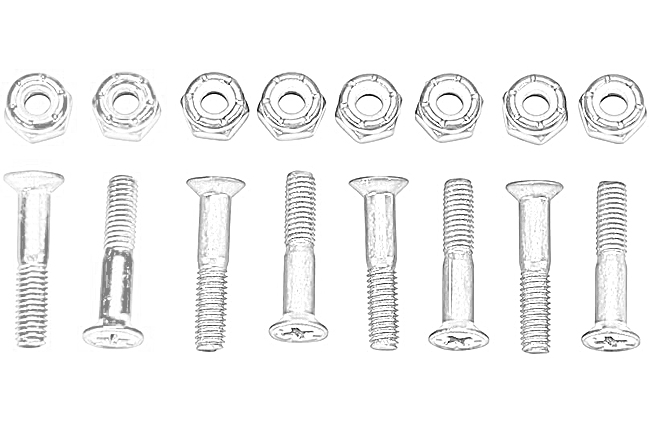
Skateboard hardware (mounting bolts) connects trucks to the deck. Bolts come in Phillips or Allen heads, various lengths and often color-coded so you can mark the nose of your board.
Every setup needs one hardware set: 8 bolts and 8 locknuts.
6.2 Skateboard hardware / Length
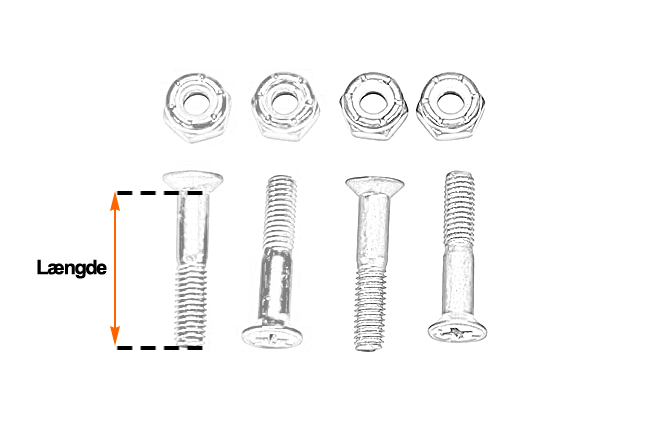
General hardware length guide (fits most boards; thick 9-ply decks or rental boards may need slightly longer bolts):
7/8" to 1" — no riser
1" to 1 1/8" — 1/8" riser
1 1/4" — 1/4" riser
1 1/2" — 1/2" riser
7.2 Skateboard griptape / Style
Choose your griptape
Griptape is coarse, sandpaper-like material that gives your shoes grip on the deck. It comes in many colors and patterns — black is standard, but clear tape shows graphics underneath and die-cut designs add personality.

8.1 Skateboard riser pads
Do you need riser pads?
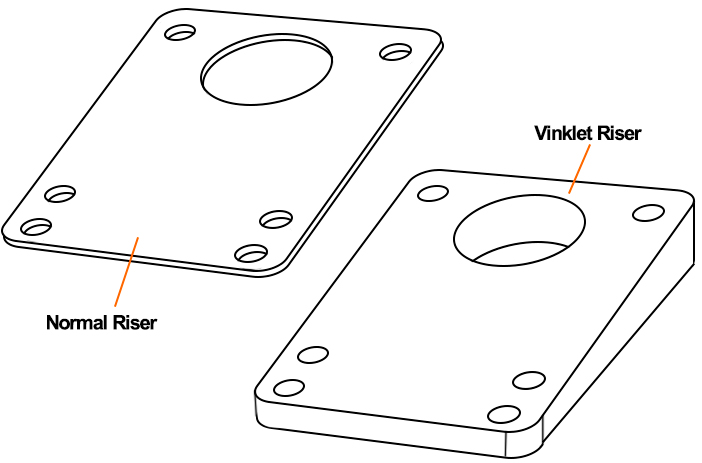
A riser pad is a flat plastic spacer between the truck and deck. It adds height so the wheel does not hit the deck in hard turns — that is wheel bite, and it stops the wheel dead.
Riser pads come in different thicknesses and colors. They can also reduce stress cracks where trucks meet the deck.
Wheels under 55 mm usually do not need risers; a 1/8" riser can still help keep hardware from vibrating loose.
Bigger wheels mean more wheel-bite risk. Longer boards with larger wheels generally need taller riser pads.