


Penny Board Guide
Wondering what patented plastic means? “Nickel”? “22” vs “27”? Durometer? “ABEC-7”? Concave? Trucks? Penny deck? 78A or 83A?
Penny is both a brand and a category. After Ben Mackay started making plastic skateboards in Australia, “Penny board” became shorthand for any small plastic cruiser — so mini cruiser is often used as a synonym. Below we explain the most common terms. Questions? Contact us.
Shop mini cruisers
There are two main penny board deck sizes: the classic and the slightly larger Penny Nickel (Big Mamma). The difference is length, width and — most importantly — stability.
Penny Classic: 56 cm (22”) x 15 cm (6”)
Penny Nickel (Big Mamma): 69 cm (27”) x 19 cm (7.5”)

Shop mini cruisers
The deck on a classic Penny board is compact and easy to carry. You have enough room to push comfortably, but just enough platform for a casual cruise along the boardwalk. The short length keeps some flex without feeling unstable — though you may have seen videos of people driving over a Penny without breaking it; that is called “bottoming out.”
The deck on a Penny Nickel is longer and feels more like a longboard. Comfort is higher and it is easier to stand on — especially for beginners and riders with bigger feet.
Shop mini cruisers
A penny skateboard is shaped like a small surfboard with a kicktail at one end. The deck is plastic, which gives it a little flex.
Some brands advertise patented plastic (Penny, NAKED, Globe), transparent plastic (Sunset, Annox), or nylon. The material on most plastic cruiser decks is almost the same. Many boards come from the same factories under different brands — patented plastic alone does not guarantee better quality.
Cheaper boards often use softer, more flexible plastic; transparent decks tend to use stiffer plastic. A stiffer penny deck is generally more stable than a very flexy one.
Shop mini cruisers Shop griptape
Most Penny skateboards are built to go anywhere. Foot grip comes from a waffle-style pattern molded into the plastic itself — often called waffle or non-slip grip.
That differs from a regular skateboard, which uses griptape (sandpaper-like sheet) for stronger grip — rough on bare hands, but very secure under your shoes. You can also buy griptape cut for penny decks if you want extra grip.

Shop mini cruisers
Penny wheels are sized by diameter. Most complete boards use 59 mm wheels — on both Classic and Nickel decks. That size balances comfort and maneuverability on mini cruisers and penny boards.
Larger-diameter wheels roll more smoothly over cracks and rough pavement but turn less quickly and feel bulkier.
Smaller penny wheels change direction faster but feel less stable on uneven ground.

Shop mini cruisers
Penny board wheel hardness is measured on the durometer A scale from 0 to 100A — 100A is the hardest.
Soft penny wheels are more comfortable and roll better over rough surfaces. They wear faster and create more friction.
Hard penny wheels roll faster with less friction but feel harsher on rough pavement.

Shop mini cruisers
Should you choose 78A, 80A or 83A? Base it on your weight and the surfaces you ride. Heavier riders create more resistance — soft wheels also wear down faster than hard ones.
Smooth, new asphalt suits 80A or 83A wheels.
Moderate to rough pavement is best with 78A–80A wheels.
(Tip: beginners should avoid their first session on very rough or cracked pavement.)
Shop mini cruisers
Penny skateboard bearings let the wheels spin smoothly with minimal friction. Bearings contain 6, 7 or 8 balls held between inner and outer races, spaced by a retainer (cage). They are usually sealed with one or two shields.
Each wheel uses two bearings — one pressed into each side, separated by a bearing spacer. The same bearing standards apply to longboards, inline skates and skateboards.

Shop mini cruisers
Bearings are often rated by ABEC (Annular Bearing Engineering Committee) — also called precision bearings. Bearings are typically rated 1 to 9 (some brands even sell ABEC-11). Higher numbers mean tighter manufacturing tolerances — not automatically better for skateboarding. Unrated bearings are not necessarily bad.

Shop mini cruisers
The spacer between bearings inside the wheel is often overlooked. The right spacer keeps wheels rolling smoothly and extends bearing life.
Most wheels work well with a 10 mm spacer, though some brands specify a width. Never ride without a spacer.
Many stock penny board wheels use thin aluminum spacers that can crush or deform. If that happens, switch to steel spacers.
Shop mini cruisers
If the spacer is too wide when you press the bearing into the wheel, the outer race gets pushed inward and the inner race outward. That creates extra friction, slows the wheel and shortens bearing life.
Signs of a spacer that is too wide on your penny board: slow-spinning wheels, damaged bearings.

Shop mini cruisers
With no spacer — or one that is too narrow — the inner race can get pushed inward while the outer race stays put. Same result: extra friction, slower wheels and shorter bearing life.
Signs on your penny board: slow-spinning wheels, damaged bearings, axle nuts that need constant re-tightening.

Shop mini cruisers Shop trucks
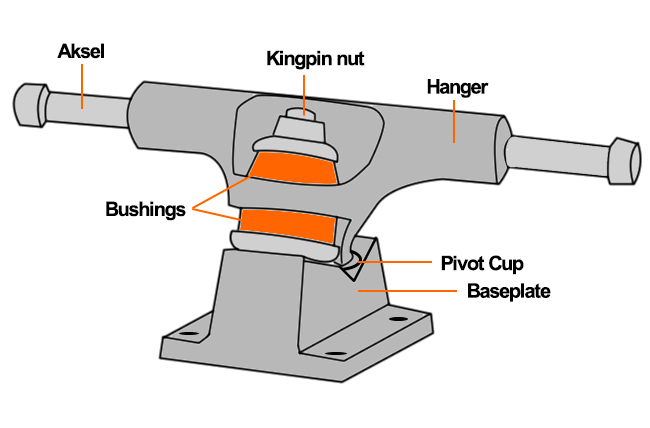
A penny board truck consists of:
Baseplate — mounts to the deck; all other truck parts attach here. Colored baseplates can make wheel or bearing swaps tricky — trim excess paint if needed.
Hanger and axle — mounted on the baseplate; controls turning based on kingpin angle.
Kingpin — centered in a sandwich of bushings and hanger, holding everything together.
Pivot cup — sits in the baseplate and lets the hanger pivot smoothly.
Speed rings — small washers on each side of the wheel when tightened to the axle; let you tighten axle nuts without crushing bearings. Penny setups use one set outside the bearings or one on each side.
Shop mini cruisers
Truck quality on penny boards is hard to judge from photos alone. Weight, brand and especially bushings (next section) are the best clues.

Shop mini cruisers
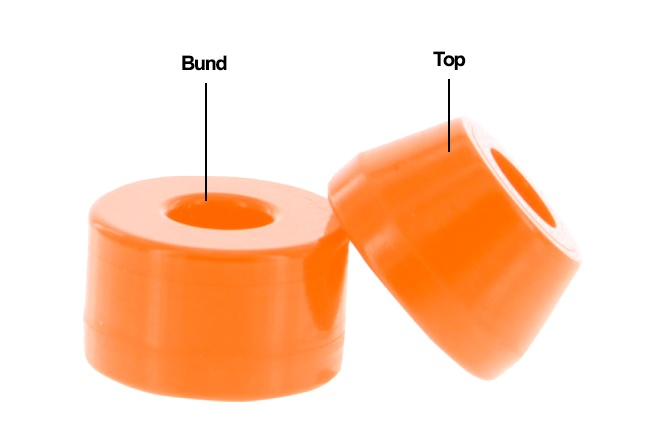
Bushings on cheap penny boards are often too hard, so the board will not turn properly — usually a sign the maker never tested the complete setup.
Good bushings are relatively soft: roughly 75A (very soft — lighter riders) to 85A (harder — heavier riders). Too soft? Tighten the kingpin nut for more stability. Too hard? Loosen slightly — but not so much that you have to disassemble the truck.
Euroskateshop stands behind penny boards from NAKED, Globe, Penny, Story and Annox — with bushings that turn smoothly out of the box.
Shop mini cruisers
The question we hear most: Penny Classic or Penny Nickel?
Penny Classic and Penny Nickel (Big Mamma) are the two standard sizes for penny boards. They look similar in photos but ride very differently — so choose carefully. Both use the same wheels, bearings and bushings; deck size and trucks differ. Compare them below.
As the table shows, the Nickel’s extra length and wider trucks add stability — a better pick if you have never stepped on a board. Learn on a Penny Classic first, though, and you can ride almost anything afterward.
The Nickel is bulkier and harder to stash in a backpack. Extra size and weight mean more stability and the ability to handle more speed.
Coming from a longboard or skateboard, a Classic’s tiny platform can feel strange. Big feet or a need for speed? Choose the Nickel.
Shop mini cruisers
A penny board and a skateboard are not the same thing.
They are built for completely different jobs.
A penny board is for cruising and commuting with comfort: soft wheels, higher ABEC bearings and medium deck flex.
A skateboard is built for parks and street tricks where the deck takes repeated impacts. Strength, weight and grip matter — hard wheels, lower ABEC ratings and a stiff maple deck with no flex.

Shop mini cruisers
A penny board and a longboard are almost the same idea.
There is not a huge gap between a cruiser longboard and a penny board. The biggest difference is size — both are meant for cruising, commuting and fun on the street with comfortable setups.
Both typically use soft wheels, higher-ABEC bearings and medium deck flex. Think of a penny board as a shrunk-down longboard.

Wondering what patented plastic means? “Nickel”? “22” vs “27”? Durometer? “ABEC-7”? Concave? Trucks? Penny deck? 78A or 83A?
Penny is both a brand and a category. After Ben Mackay started making plastic skateboards in Australia, “Penny board” became shorthand for any small plastic cruiser — so mini cruiser is often used as a synonym. Below we explain the most common terms. Questions? Contact us.
1) Penny deck
1.1 Penny deck / Introduction
Shop mini cruisers
There are two main penny board deck sizes: the classic and the slightly larger Penny Nickel (Big Mamma). The difference is length, width and — most importantly — stability.
Penny Classic: 56 cm (22”) x 15 cm (6”)
Penny Nickel (Big Mamma): 69 cm (27”) x 19 cm (7.5”)
1.2 Penny deck / Length
Shop mini cruisers
The deck on a classic Penny board is compact and easy to carry. You have enough room to push comfortably, but just enough platform for a casual cruise along the boardwalk. The short length keeps some flex without feeling unstable — though you may have seen videos of people driving over a Penny without breaking it; that is called “bottoming out.”
The deck on a Penny Nickel is longer and feels more like a longboard. Comfort is higher and it is easier to stand on — especially for beginners and riders with bigger feet.
1.3 Penny deck / Material
Shop mini cruisers
A penny skateboard is shaped like a small surfboard with a kicktail at one end. The deck is plastic, which gives it a little flex.
Some brands advertise patented plastic (Penny, NAKED, Globe), transparent plastic (Sunset, Annox), or nylon. The material on most plastic cruiser decks is almost the same. Many boards come from the same factories under different brands — patented plastic alone does not guarantee better quality.
Cheaper boards often use softer, more flexible plastic; transparent decks tend to use stiffer plastic. A stiffer penny deck is generally more stable than a very flexy one.
1.4 Penny deck / Grip pattern
Shop mini cruisers Shop griptape
Most Penny skateboards are built to go anywhere. Foot grip comes from a waffle-style pattern molded into the plastic itself — often called waffle or non-slip grip.
That differs from a regular skateboard, which uses griptape (sandpaper-like sheet) for stronger grip — rough on bare hands, but very secure under your shoes. You can also buy griptape cut for penny decks if you want extra grip.
2) Penny wheels
2.1 Penny wheels / Size (diameter)
Shop mini cruisers
Penny wheels are sized by diameter. Most complete boards use 59 mm wheels — on both Classic and Nickel decks. That size balances comfort and maneuverability on mini cruisers and penny boards.
Larger-diameter wheels roll more smoothly over cracks and rough pavement but turn less quickly and feel bulkier.
Smaller penny wheels change direction faster but feel less stable on uneven ground.
2.2 Penny wheels / Hardness (durometer)
Shop mini cruisers
Penny board wheel hardness is measured on the durometer A scale from 0 to 100A — 100A is the hardest.
Soft penny wheels are more comfortable and roll better over rough surfaces. They wear faster and create more friction.
Hard penny wheels roll faster with less friction but feel harsher on rough pavement.
2.3 Penny wheels / Euroskateshop recommends
Shop mini cruisers
Should you choose 78A, 80A or 83A? Base it on your weight and the surfaces you ride. Heavier riders create more resistance — soft wheels also wear down faster than hard ones.
Smooth, new asphalt suits 80A or 83A wheels.
Moderate to rough pavement is best with 78A–80A wheels.
(Tip: beginners should avoid their first session on very rough or cracked pavement.)
3) Penny bearings
3.1 Penny bearings / Introduction
Shop mini cruisers
Penny skateboard bearings let the wheels spin smoothly with minimal friction. Bearings contain 6, 7 or 8 balls held between inner and outer races, spaced by a retainer (cage). They are usually sealed with one or two shields.
Each wheel uses two bearings — one pressed into each side, separated by a bearing spacer. The same bearing standards apply to longboards, inline skates and skateboards.
3.2 Penny bearings / ABEC
Shop mini cruisers
Bearings are often rated by ABEC (Annular Bearing Engineering Committee) — also called precision bearings. Bearings are typically rated 1 to 9 (some brands even sell ABEC-11). Higher numbers mean tighter manufacturing tolerances — not automatically better for skateboarding. Unrated bearings are not necessarily bad.
3.3 Penny bearings / Bearing spacer
Shop mini cruisers
The spacer between bearings inside the wheel is often overlooked. The right spacer keeps wheels rolling smoothly and extends bearing life.
Most wheels work well with a 10 mm spacer, though some brands specify a width. Never ride without a spacer.
Many stock penny board wheels use thin aluminum spacers that can crush or deform. If that happens, switch to steel spacers.
3.4 Penny bearings / Spacer too wide
Shop mini cruisers
If the spacer is too wide when you press the bearing into the wheel, the outer race gets pushed inward and the inner race outward. That creates extra friction, slows the wheel and shortens bearing life.
Signs of a spacer that is too wide on your penny board: slow-spinning wheels, damaged bearings.
3.5 Penny bearings / Spacer too narrow
Shop mini cruisers
With no spacer — or one that is too narrow — the inner race can get pushed inward while the outer race stays put. Same result: extra friction, slower wheels and shorter bearing life.
Signs on your penny board: slow-spinning wheels, damaged bearings, axle nuts that need constant re-tightening.
4) Penny trucks
4.1 Penny trucks / Introduction
Shop mini cruisers Shop trucks
A penny board truck consists of:
Baseplate — mounts to the deck; all other truck parts attach here. Colored baseplates can make wheel or bearing swaps tricky — trim excess paint if needed.
Hanger and axle — mounted on the baseplate; controls turning based on kingpin angle.
Kingpin — centered in a sandwich of bushings and hanger, holding everything together.
Pivot cup — sits in the baseplate and lets the hanger pivot smoothly.
Speed rings — small washers on each side of the wheel when tightened to the axle; let you tighten axle nuts without crushing bearings. Penny setups use one set outside the bearings or one on each side.
4.2 Penny trucks / Quality vs budget trucks
Shop mini cruisers
Truck quality on penny boards is hard to judge from photos alone. Weight, brand and especially bushings (next section) are the best clues.
4.3 Penny trucks / Bushings
Shop mini cruisers
Bushings on cheap penny boards are often too hard, so the board will not turn properly — usually a sign the maker never tested the complete setup.
Good bushings are relatively soft: roughly 75A (very soft — lighter riders) to 85A (harder — heavier riders). Too soft? Tighten the kingpin nut for more stability. Too hard? Loosen slightly — but not so much that you have to disassemble the truck.
Euroskateshop stands behind penny boards from NAKED, Globe, Penny, Story and Annox — with bushings that turn smoothly out of the box.
5) Penny vs Nickel
Shop mini cruisers
The question we hear most: Penny Classic or Penny Nickel?
Penny Classic and Penny Nickel (Big Mamma) are the two standard sizes for penny boards. They look similar in photos but ride very differently — so choose carefully. Both use the same wheels, bearings and bushings; deck size and trucks differ. Compare them below.
| Specs | Penny Classic | Penny Nickel |
|---|---|---|
 |
 |
|
| Length | 56 cm (22”) | 69 cm (27”) |
| Width | 15 cm (6.0”) | 19 cm (7.5”) |
| Weight | 2000 g | 2500 g |
| Trucks | 7.62 cm (3”) | 10.2 cm (4”) |
| Wheel diameter | 59 mm | 59 mm |
| Beginner (never skated) | Hard | Easy |
| Stability | Poor | Good |
| Speed | Poor | Average |
| Kids | Average | Average |
| Easy to carry | Good | Average/poor |
| Surf feel | Good | Good |
As the table shows, the Nickel’s extra length and wider trucks add stability — a better pick if you have never stepped on a board. Learn on a Penny Classic first, though, and you can ride almost anything afterward.
The Nickel is bulkier and harder to stash in a backpack. Extra size and weight mean more stability and the ability to handle more speed.
Coming from a longboard or skateboard, a Classic’s tiny platform can feel strange. Big feet or a need for speed? Choose the Nickel.
6) Penny vs skateboard
6.1 Penny vs skateboard
Shop mini cruisers
A penny board and a skateboard are not the same thing.
They are built for completely different jobs.
A penny board is for cruising and commuting with comfort: soft wheels, higher ABEC bearings and medium deck flex.
A skateboard is built for parks and street tricks where the deck takes repeated impacts. Strength, weight and grip matter — hard wheels, lower ABEC ratings and a stiff maple deck with no flex.
7) Penny vs longboard
7.1 Penny vs longboard
Shop mini cruisers
A penny board and a longboard are almost the same idea.
There is not a huge gap between a cruiser longboard and a penny board. The biggest difference is size — both are meant for cruising, commuting and fun on the street with comfortable setups.
Both typically use soft wheels, higher-ABEC bearings and medium deck flex. Think of a penny board as a shrunk-down longboard.