


Longboard Guide
Ever wonder what it means when a longboarder is stoked because their slides are “buttery” or “icy”? This guide covers the most important longboard terms and topics — so you can talk the talk and pick the right setup. Look up a full subject or just find a single word you do not understand.
Longboarding has exploded over the last few years. Anyone can ride — kids and adults, beginners and experienced skaters. The key is choosing a board that matches how you want to ride. Browse our complete longboards online or in store.
How do I start longboarding?
The easiest way to get started is to buy a complete longboard — ready to ride out of the box. You can also buy parts separately and build your own: deck, trucks, wheels and bearings. Always wear protective gear. At minimum, wear a helmet. We also recommend knee, elbow and wrist protection.Most people have a dominant leg. In skateboarding and longboarding, riding with your left foot forward is called “regular”; right foot forward is “goofy.” Riding with your non-dominant foot forward is called “switch.”
1.1 Riding styles
There are many longboarding styles. These basic terms help you understand the sections below:
Pushing is the motion you use with your foot to move the board forward and keep or gain speed.
Pumping means quick, repeated turns that generate speed without pushing.
Sliding is turning the board sideways so the wheels break traction. Controlled slides are the foundation of freeride. You need speed to practice them.
Before you buy, decide which style you will ride most. Your riding style should drive your board choice.
Carving: longboards are built for wide, flowing turns — similar to snowboarding or surfing. Repeated carves down a hill let you control speed without constantly accelerating, like edging on a snowboard.


Slalom means weaving through a line of cones. Riders use quick, small turns to complete the course. Slalom boards are often shorter than typical longboards.
2. Short breakdown of a complete longboard
Besides the deck, a complete longboard has three main parts: wheels, trucks and bearings. Euroskateshop completes come with components matched to the riding style each board is built for.2.1 Longboard parts / Deck
A longboard deck is made from wood. Ply (or plies) tells you how many layers of maple, bamboo and/or fiberglass veneer make up the board. The glue holding the layers together is called lamination. The platform is where you stand.Deck length is often overestimated. Wheelbase — the distance between the wheels — affects turning more than total board length. Still, these length guidelines are a useful starting point:
under 70 cm (<20”) — transport and cruising
70–95 cm (28”–38”) — carving and freestyle
95–107 cm (38”–42”) — freeride, carving, downhill and sliding
over 107 cm (>42”) — cruising, downhill and sliding
Flex feels great at low speeds — comfortable and fun. At high speeds, too much flex reduces stability and can cause speed wobbles. Match flex to how fast you plan to ride.


2.2 Longboard parts / Deck shapes
A directional board is asymmetrical — nose and tail differ. Directional decks suit high-speed riding and racing where you rarely ride switch. A twintip is symmetrical front and back, so you can ride both ways and learn switch more easily.Kicktails are upturned nose and/or tail sections used to pop the board, do manuals and freestyle tricks.
Cut-outs: material removed above the wheels on twintip decks to prevent wheelbite in hard turns. Cut-outs let you run large wheels on a low platform.
Wheel wells: shallow pockets on the underside above the wheels for extra clearance when turning.
Gas pedals: sanded or angled rail sections that help you press the edge of the deck with your foot — useful for initiating slides.

View the deck from the side to see its profile:
Camber: the deck curves upward (inverted U). Common on flexy boards; helps prevent the deck from bottoming out under your weight.
Rocker: the deck curves downward in the middle (U-shape). More ergonomic foot position and better board feel — popular for freeride.
Drop-down platform: a top-mounted deck where the standing platform sits lower than the truck mounts. Lowers your center of gravity for stability and easier pushing.
Wedged: similar to drop-down, but trucks mount on the curved nose and tail. Responsive feel — great for cruising and carving, and sometimes freeride.

W-concave: adds a central ridge along the length of the deck, forming a W shape from either end. Used on downhill and freeride setups where feedback matters.
3D concave: extra concave above the wheel wells only — more material to push against when sliding. Common on downhill and freeride decks.

3. Trucks
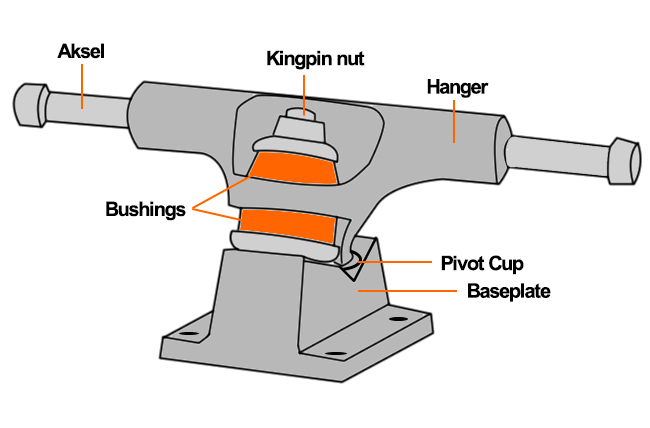
Trucks connect the wheels to the deck and let the board turn. Below is a breakdown of truck anatomy and setup.3.1 Longboard parts / Trucks
Base plate: mounts directly to the deck; the holes align with the deck hardware.Hanger: holds the axle and pivots in the base plate.
Axle: runs through the hanger; wheels mount here.
Kingpin: the main bolt through the hanger — the truck’s pivot point.
Bushing seat: the pocket in the hanger where bushings sit.
Pivot cup: the cup in the base plate where the hanger pivot sits.
Speed rings: small washers that let you tighten wheels without crushing bearings.
Conventional (traditional): standard skateboard truck geometry. Works on longboards but usually less comfort and control than reverse kingpin.
Reverse kingpin (RKP): the longboard standard. The kingpin angles away from the board center, increasing turning radius but adding stability.
Truck angle: measured between the kingpin and base plate. Steeper angle = tighter turns. Shallower angle = wider turns and more stability.
Loose trucks: adjusted to turn easily — or poorly adjusted.
Tight trucks: in pro longboarding, trucks set up for minimal turn and maximum stability.
Rake: describes hanger geometry; some hangers can be flipped for a different effective angle.
Springs: some specialty trucks use springs for a surf-like feel.

3.2 Longboard parts / Truck assembly
Top mount: trucks mount under the deck like a standard skateboard — maximum grip, common for downhill.Drop-through: the base plate mounts through cut-outs in the deck, lowering ride height and increasing stability.
Double drop: combines a dropped platform with drop-through trucks — very low, popular for LDP.

3.3 Longboard parts / Truck bushings
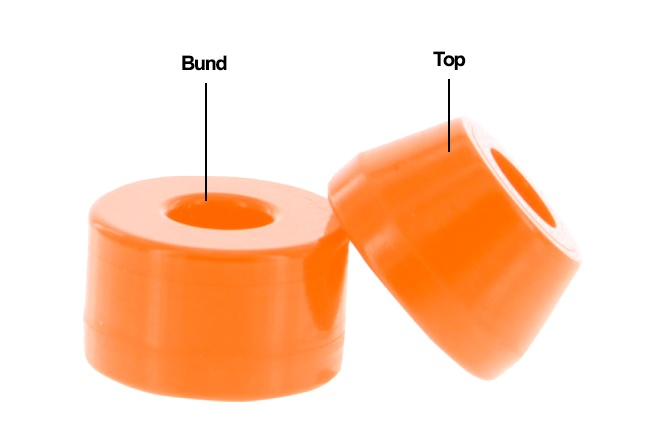
Bushings are urethane cushions that control how your trucks turn. Hardness is measured on the durometer scale — the same system used for wheels.A typical setup uses a short cone bushing on top of the hanger and a taller barrel bushing underneath.
Barrel bushings: restrict hanger movement for more stability — common on downhill setups.
Stepped barrel: even more stable; extra material in the middle seats deeper in the bushing pocket.
Cones: allow more turn — great for carving and cruising.
4. Wheels and bearings
Modern longboard wheels are urethane. Budget boards may use PVC wheels — avoid them if you can. Durometer hardness is usually rated on the A scale; most longboard wheels fall between 78A and 84A.4.1 Longboard parts / Contact patch
The contact patch is the part of the wheel that touches the pavement — not the same as overall wheel width.Stone-ground: the contact patch is pre-worn at the factory so the wheel slides more easily from day one.
Coning: uneven wear from sliding — more wear on the inside than the outside, creating a cone shape.
Flat-spots: worn flat sections caused when a wheel stops spinning during a slide. Nobody likes flat-spots.

4.2 Longboard parts / Wheel lip
The wheel lip is the outer edge profile:Sharp lip (square edge): maximum grip — ideal for downhill and high-speed riding.
Rounded lip: less grip, easier slides — popular for freeride.
Bevel: a cut-away edge that helps initiate slides while keeping some structure as the wheel wears.

4.3 Longboard parts / Core placement
The core (hub) holds the bearings and strongly affects how a wheel performs:Center-set: core in the middle — most even wear and most grip.
Side-set: core at the inner edge — least grip, easiest to slide. Good when you are learning slides.
Offset: core slightly off-center — a balance of grip and slide-ability.

4.4 Longboard parts / Bearings
Bearings are often rated by ABEC (Annular Bearing Engineering Committee) — a precision scale. Higher ABEC means tighter manufacturing tolerances. Not every brand uses ABEC; for skateboarding, seal quality, materials and construction matter just as much.Steel bearings are durable and affordable. Ceramic balls are harder to machine precisely, run cooler and suit high-speed and downhill riding. Swiss-made bearings are known for exceptional precision.
Balls: usually seven per bearing in longboard setups.
Inner race: the inner ring that sits on the axle.
Outer race: the outer ring that sits in the wheel.
Shield: keeps dirt out. Rubber shields can be removed for cleaning; metal shields usually cannot.
Spacers: sit between bearings inside the wheel so you can tighten your axle nut without damaging the bearings. Use the correct spacer size for your setup.

Shop our skateboard bearings from ABEC-7 to ABEC-11. Euroskateshop stocks smooth-rolling longboards, skateboards, scooters and penny boards. Questions? Contact us by phone or email.
5. At high speeds, the risk of serious injury goes up
Wear protection — at minimum a helmet. You only get one head.5.1 Protective equipment
Protective gear serves two roles: (1) protection from rare but violent impacts, and (2) padding for the small bumps you know are coming.Helmet: the most important piece. It should fit snugly. Downhill riders often use full-face helmets — similar to motorcycle helmets — for full head and face protection.
Slide gloves: longboard-specific gloves with hard palm pucks. Used to place your hand on the ground at speed to stabilize slides — they protect your palms, not your wrists.
Pucks: the hard plastic blocks in the palm of slide gloves.
Pads: knee and elbow pads; hip pads are also available.